Case Study · Insurance Claims
New hires performing like senior employees in six weeks.
An insurance claims call center wanted to close the performance gap between new employees and top performers — fast. We listened first, then built an AI system that proved the hypothesis in three months.
New employee performance improvement
within 6 weeks of rollout
NPS before
NPS after
The Situation
A performance gap
that kept resetting.
Insurance claims calls are high-stakes and emotionally charged. Senior call center employees had developed instincts for reading callers, steering conversations with empathy, and keeping NPS scores high. New employees hadn't — and high turnover meant those instincts were constantly being rebuilt from zero.
The client had a clear-eyed view of the problem: it wasn't a training deficit, it was a context deficit. New employees didn't know who they were talking to, couldn't adapt their tone quickly enough, and had no in-the-moment guidance when a call started going sideways.
Their hypothesis was specific and testable: operationalizing empathetic scripts, combined with location and ambient data to prompt genuine small talk at call start, could close the gap. And if small-talk engagement correlated with better call outcomes, they'd know exactly where to invest.
They knew it would require multi-agent orchestration. What they needed was a firm that could identify the low-hanging fruit, deliver measurable wins inside three months, and use those results to prioritize where to scale — not a platform commitment before proof existed.
We Listened First
Before we built anything,
we became students.
For two weeks, we sat with call center employees — new hires and senior high-performers alike. We listened to calls. We mapped what top performers did instinctively that new employees didn't. We identified the moments where a call pivoted: when empathy landed, when it didn't, when small talk opened a difficult conversation instead of stalling it.
Observed top performers
Mapped the patterns senior employees used instinctively — tone shifts, empathy cues, small-talk timing, how they read early caller signals and adapted mid-call.
Observed new employees
Identified where new hires struggled most: reading caller context, choosing the right opening, recovering when a call went sideways early. The gap was specific, not vague.
Identified the highest-leverage intervention
Persona context at call start and adaptive script guidance in the moment — not a script to read verbatim, but a prompt that gave employees the right frame for this specific caller.
Defined what we'd measure
Agreed in advance on the KPIs and correlation scores that would validate the hypothesis. The analytics layer wasn't an afterthought — it was designed before the POC was built.
The POC
Three agents.
One cohesive system.
The observation phase told us where to focus. We presented a POC scoped to two tightly integrated capabilities: an AI system that gives employees better context at the start of every call, and an analytics layer that answers the correlation question the business cared about.
Built on their existing Microsoft infrastructure. No new vendor stack. Running in production within the three-month window.
Caller persona profiles
An AI agent that builds a real-time profile of each inbound caller — location, ambient context, prior interaction history, account status, likely emotional state. Available to the employee at call start, before the first word.
Adaptive empathy scripts
Dynamic script guidance served to the employee in the moment — not a static script, but prompts calibrated to this caller's profile. Small-talk suggestions based on location. Tone guidance based on call context. Updated as the call progresses.
Hourly KPI analytics with correlation scoring
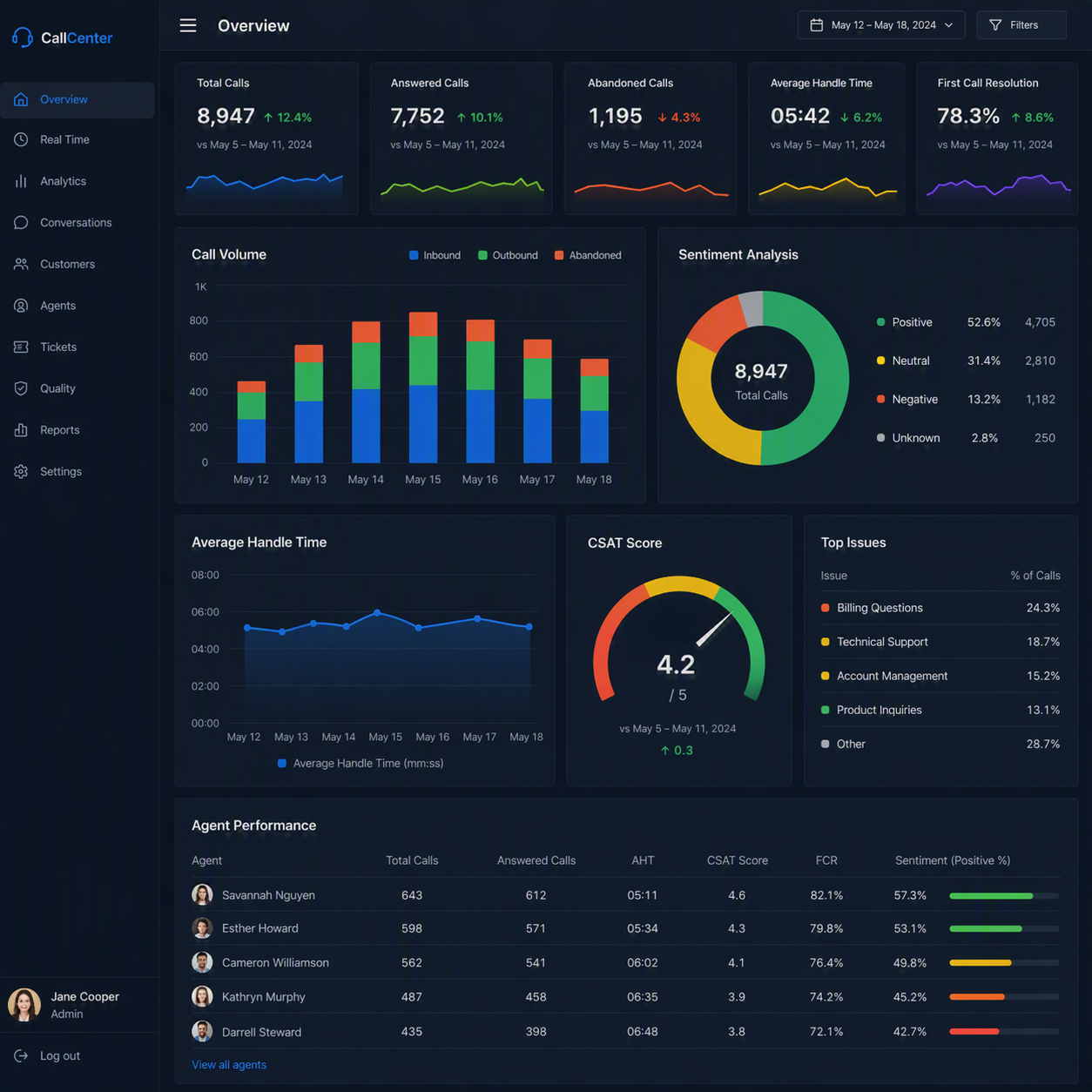
An hourly report surfacing call performance metrics — resolution rate, handle time, customer sentiment — alongside correlation scores for small-talk engagement. Supervisors could see, in near real time, whether the hypothesis was holding.
How we ran the engagement — POINT
Prioritize the Problem
New employees were taking too long to match the performance of senior high-performers — and many were leaving before they got there. High turnover compounded the problem. The KPI was clear: close the performance gap for new hires faster, and measure it in weeks, not quarters.
Outline the Win
The client had a sharp hypothesis — empathetic scripts and ambient context (caller location, time of day) could unlock better small-talk, warmer calls, and stronger outcomes. They wanted to test whether that correlation was real and, if so, at what scale to invest. We built the value case around a 3-month POC with measurable outcomes as the gate for expansion.
Implement Rapidly
Two weeks of structured observation. Then a focused POC: an AI system that builds persona profiles of inbound callers and serves adaptive, empathetic scripts to employees in real time. Layered over that: an hourly analytics report showing call KPIs alongside correlation scores for small-talk engagement. No guessing — the numbers either backed the hypothesis or they didn't.
Normalize the New Workflow
Script prompts and persona cues were embedded directly into the employee experience — visible at call start, updated dynamically. Hourly KPI reports became part of supervisor workflows. New employees started using the tooling on day one of onboarding, closing the experience gap before it had a chance to form.
Track and Expand
New employee performance KPIs improved 78% within six weeks. NPS moved from +50 to +75. The correlation between small-talk engagement and call success was real and statistically meaningful. Those numbers unlocked Phase 2 and Phase 3 — a year-long engagement expanding AI across the call center operation.
Learn more about the POINT framework → How We Deliver
Outcomes
The hypothesis
was correct.
Small-talk engagement correlated with better call outcomes — and the data showed it. Within six weeks of the pilot going live, new employee performance KPIs had improved 78%. NPS moved from +50 to +75.
Those numbers did something else: they told the client exactly where to invest next. The pilot hadn't just proved the concept — it had built the prioritization case for Phase 2 and Phase 3 without any guesswork.
Performance gain
new employee KPIs in 6 weeks
NPS growth
50% improvement in NPS score
Correlation confirmed
Small-talk engagement, calibrated by caller persona, showed statistically meaningful correlation with resolution rates and customer sentiment scores. The hypothesis held.
Pilot success → Phase 2 + Phase 3
Measured results unlocked two additional phases of the engagement. The client knew exactly what to scale and why — no guesswork, no internal politics to navigate. The data made the case.
Year-long engagement awarded
CommonLogic moved from POC partner to primary AI delivery firm across the call center operation. Multi-agent orchestration expanding to supervisor tooling, quality scoring automation, and workforce analytics.
Know where the gap is.
Not sure how to close it?
We'll observe before we build, define what success looks like before we start, and deliver measurable results inside three months — or we'll tell you why not to proceed.
Talk to us